
Human beings love metrics. We track our “step count”. We want “likes” on social media. Credit agencies even invented a “credit score” that tells us if they trust us or not.
Business people love metrics even more. We create and review dashboards. We compare actuals to forecast. We even wander into hotel ballrooms to hear “Economic Outlook” speeches so someone can tell us which metrics matter the most. There is a deep satisfaction we get when something finally clicks. When we truly understand something. Metrics help create that moment for us and I believe is the reason why we love them so much.
But too much of a good thing is a bad thing. Metrics become meaningless when they are diluted with more metrics. This is why baseball nerds love “WAR” (Wins Above Replacement). WAR is a metric that takes every baseball stat you can imagine, smooshes them together, and distills them into one beautiful number that tells you how good a player really is. Einstein explained the entire physical universe to us with one formula: E = mc2. Why isn’t there anything like that in business?
To take this point further, consider the following thought experiment: imagine every business metric in the world falls into a black hole and is gone forever (EBITDA, Debt Service Coverage Ratio, etc.). But you get to save a single metric. Which one do you choose? What is the Greatest Metric of All Time?
I am going to share my opinion (keep reading), but the real answer is, unfortunately, anticlimactic. Most metrics are situational. Revenue matters until it isn’t profitable. Profitability matters until growth becomes the priority. Valuation matters right up until the bank account starts diminishing. And unlike baseball, defining success in business is not as simple as the amount of games won. There isn’t a silver bullet for every company. But I will make my case for one anyway…
After working around distressed companies and tight situations, I’ve come to my conclusion:
Net Liquidity is the greatest metric of all time.
If running a business were a game, the game is over when your Net Liquidity hits $0. Not when EBITDA turns negative. Not when your valuation drops. When the cash is gone and the line is tapped, that is when the lights go out. How then is Net Liquidity not the most important metric?
Net Liquidity is just two things added together: the cash sitting in your bank account and the availability on your line of credit. That’s it.
Those two numbers are the result of everything happening inside a business. Sales, payroll, accounts payable, customer terms, borrowing base calculations, and more. The numbers are blended together into one clean, meaningful number that tells you exactly where you stand.
The only way I know how to properly track it is with a Cash Flow Forecast. It pulls every relevant business number into one place, projects it forward, and gives you a picture of where you are headed. It answers two questions: how much liquidity do I have right now, and how much will I have in the future?
Here is what it looks like in practice:
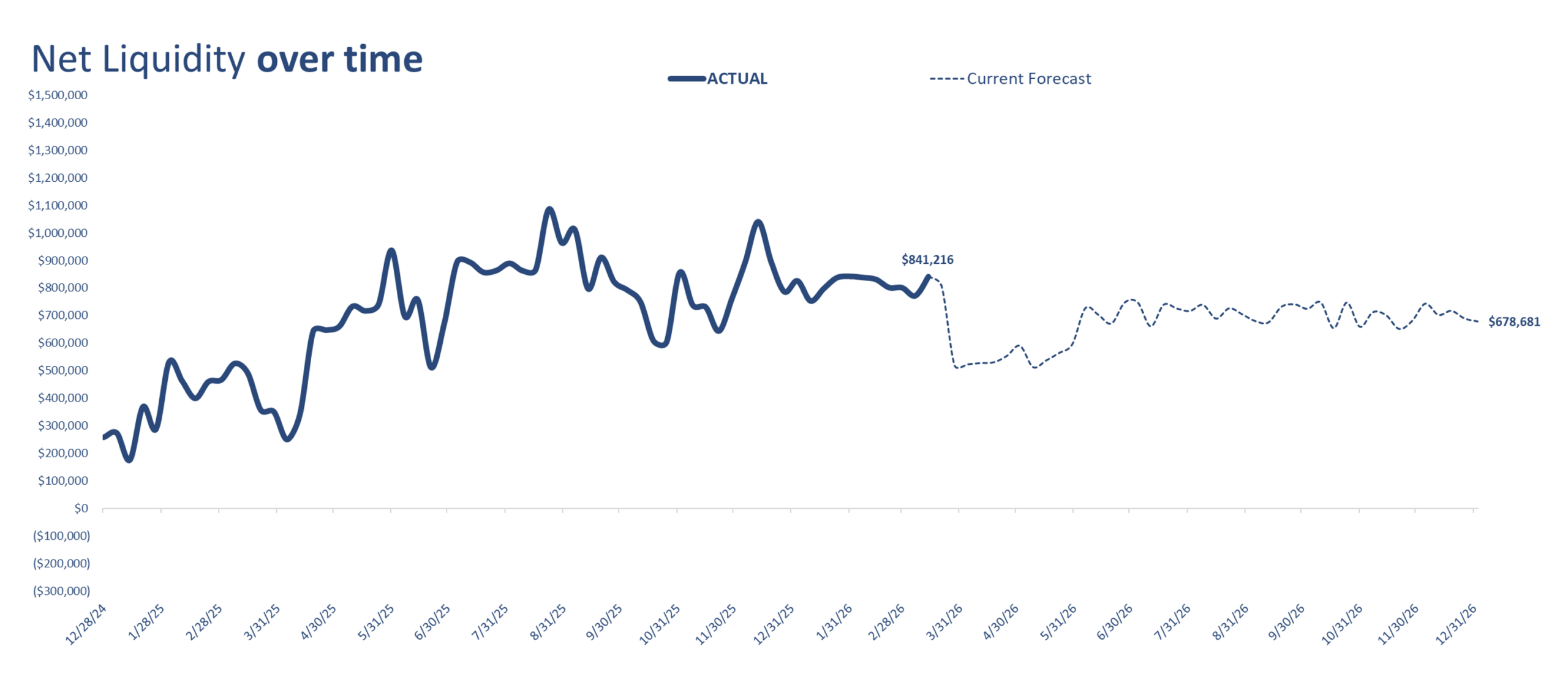
Tracking Net Liquidity is critical because it tells you how long you can survive under stress, how much time you have to respond to a challenge, and whether you can afford to go on offense. Want to buy that new machine? Pay down debt faster? The question is always the same: how much liquidity are you going to have?
Is Net Liquidity perfect? Of course not. No single number ever is. But if you forced me to save one from the black hole, Net Liquidity would be it.

This post was written by Ryan Seely
rseely@dwhcorp.com | LinkedIn
All companies experience change.
Plan for it with us.



 top
top